
A Virginia Beach Roofing Company serving all of Hampton Roads and this is our blog.
Saturday, October 4, 2014
Why Metal Roofing is The Best!
When placing a roof on a constructing, the choice of roofing program for the creating can frequently make a big distinction in the energy efficiency and durability. Total, the selection of roof development can greatly affect the fees both throughout development and in excess of the prolonged term existence of the roof. Here are 5 rewards to metal roofing: A metal roof is extremely light-weight in comparison to other selections. There is a very high strength to bodyweight ratio in metal roofs. Simply because of this, quite large roofs can be constructed out of metal, sometimes going over twenty,000 square feet of steel sheeting for a single developing. Has a excellent "green" issue with a excellent efficiency with heat using awesome-roof paints and a large level of emissivity, as nicely as being open to recycling. For instance, making a totally recycled aluminum roof only calls for 5% of the power than it does to make a entirely new roof. Due to the fact of this, metal construction products for roofing are readily offered with a higher level of recycled content. Extremely resistant to weather effects, which includes fire, hail, and wind. Also tough in the direction of aging, which signifies these roofs often come with a lifetime replacement warranty. The lifespan of a normal residential/commercial grade metal roof is 50 to 100 or much more many years, depending on the variety of metal employed. Little to no servicing essential. There are also downsides to employing metal roofing, despite the fact that not as well several. Here are five disadvantages to metal roofing: With massive roofs, thermal motion have to be taken into consideration throughout set up. If accomplished appropriately, although, it truly is a one particular-time concern. Adjust in temperature can cause roofing noise in some situations, despite the fact that this is rather rare. Specified combinations of metals can trigger accelerated corrosion in the metal. Yet again, if carried out appropriately, it is a 1-time concern. Production of metal parts is costly for the two money and energy, though recycling can reduce these costs immensely. Transportation of metal elements may call for further travel during development, increasing some expenses.

Factors to look out for when employing a contractor
A good deal of work - and inconvenience - goes into a key roof restore or a roof substitute. We're house owners! How can we be confident we do the proper issues? Make the proper choices? Inquire the appropriate concerns? Retain the services of the right roofing contractor? No one can ever be 100% certain, but there is a single stage you can consider to support you solution inquiries and have a much better notion about what you're carrying out. The Oregon Building Contractors Board (CCB) is the state entity charged with the accountability of licensing anybody who will get paid to make an improvement to genuine residence by performing any sort of construction work. The titles listed beneath are from a checklist of common mistakes the CCB sees in the scope of their regulatory duties. The CCB can be contacted at @ or by calling 503-378-4621. Their fax amount is 503-373-2007. one. Not checking the contractor license Prior to you get in touch with any contractors to get bids, and particularly ahead of you indicator a contract with any contractor, examine with the CCB to confirm that the contractor you have chosen is licensed. In buy to be licensed, the contractor have to place up a surety bond and demonstrate that they carry liability insurance and Workers' Comp. Insurance. A CCB surety bond provides a constrained sum of fiscal protection for house owners by paying out the value of getting rid of, repairing or replacing negative perform by the contractor on buy by the CCB. "Insured" implies that the contractor presented proof of general liability insurance coverage to the CCB that gives coverage if the contractor - in the scope of his perform - is found liable for a reduction due to bodily injury or house. The CCB can also let you know if the contractor has had any prior complaints. Essential: Home owners are unable to recover damages through the OCCB surety bond if they use an unlicensed contractor. two. No written contract A written contract provides protection for the house owner and the contractor and is, in reality, needed on all building agreements in which the price exceeds $2000.00. Irrespective of the cost, it is a good practice to usually have a written contract. Verbal contracts are difficult to prove in a court of law in case there is a disagreement Not having a contract is one of the largest problems property owners make when hiring a contractor. three.. Not obtaining a lot more than one bid/Immediately accepting the lowest bid. The old adage "you get what you pay out for" applies when dealing with contractors. The lowest bid isn't necessarily the most value efficient. Be sure to search more than several bids before deciding on. Roof Contractor Portland Oregon encourages you to evaluate estimates and contracts. It is recommended that a house owner get at least three written bids ahead of employing a contractor. Make certain that e ach bid lists precisely the same factors: requested work, very same material getting bid, and exact same solutions becoming bid. The steepness of the roof and the weight of the shingles are utilized to determine the cost of labor. The cause for this is because the two of these aspects make the work more difficult, so it also tends to make the bid much more costly! Keep in mind that the most economical bid may not be the ideal selection. There could have been a mistake or anything was accidently omitted. It really is also attainable that the higher bid includes far better materials and workmanship that will be well worth the added value. Request concerns about any discrepancies amongst the bids, or anything at all that you truly feel needs clarification. four. Not checking references Never hesitate to insist on references. Query every former customer carefully to find out as significantly about the contractor as possible. Was he punctual? Was the work satisfactory? Was perform and cleanup finished on time? In case of issues with the contractor, what was the contractor's response? Ask for addresses exactly where you can see examples of the contractor's good quality of perform. See all 2 photos five. Not carrying out the homework One of the most crucial measures that you, the homeowner, can do to ensure the good results of your repair or substitute project is to prepare carefully with your spending budget in mind. If you see some thing you like, consider note of the manufacturer, brand title or model, or discover or get pictures. Show all of your assembled strategies and samples to your contractor to bid. Being specific allows significantly less chance for misunderstandings All Surface Roofing and Development hopes these tips will aid you in picking the right contractor. Contracting on Amazon Final updated on January 24, 2013 You can support the HubPages community highlight leading quality articles by ranking this article up or down. Follow () We value your suggestions 2 feedback Bill Armstrong 2 many years ago from Valencia, California I want I had this a 12 months or so in the past to present our Board in the complex, they actually screwed this complex up with hiring the incorrect contractors, even now a pending law suit and we are all struggling due to the fact of individuals who will not pay attention and consider other people advise.. ddproofing lm 2 years in the past @Bill Armstrong: Hi billybraveheart, it is truly unfortunate that you had the incorrect contractors work on your roof. Were they the only ones offered at your area? 8192 characters left. operating Please rate this article employing the scale under. The scale is from 1 to 10, exactly where 10 is the very best and one is the worst. Your Rating: ? Copyright © 2014 HubPages Inc. and respective owners. Other merchandise and firm names proven might be trademarks of their respective owners. HubPages® is a registered Service Mark of HubPages, Inc. HubPages and Hubbers (authors) may earn revenue on this webpage based on affiliate relationships and advertisements with partners like Amazon, eBay, Google, and others.
Friday, October 3, 2014
Amateurs Help Guide To Vacation What You Should Know
Touring can be rather overwhelming to someone that has never gone on a journey just before. It may very easily lead to a amount of information and facts overload due to the fact of all the solutions you can get. Below are some tips to help you in coordinating these details to be able to start off traveling more intelligent and less hazardous. Think about visiting tiny cities if you are with limited funds. Small towns have their own own exclusive charm and destinations. You can generally get historical districts and charming landscapes in town. Accommodations are generally very affordable. As the community is just not a visitor destination, this is an excellent option for a peaceful retreat. When you are traveling, it is essential to ensure your air carrier will satisfy your desires. Distinct airlines maintain various niches. Some are low-cost, some supply exceptional assistance, and a few focus on significantly more locations than others. Prior to deciding to publication any journey by airline, investigation different airlines very first. It will save you a frustration. Having earplugs useful while on a trip can save your sleep at night and sanity! Whether it is about the aircraft or in your hotel, the use of earplugs will enable you to close out at least 50 % of your sounds that will give you a frustration, stop you from slumbering, or otherwise showcase journey in the bad way. They are also inexpensive so provide lots. Before you traveling worldwide, understand exactly where your country's embassies and consulates have been in your destination nation. These are generally not resources for the relaxed vacationer. Ideally you will by no means need them. If you locate your self in legitimate difficulty, however, consulates and embassies can offer vital help in moving unfamiliar and unfriendly lawful seas. Many of the most unique, romantic travel destinations are in locations susceptible to disasters. Particular calamities are seasonal - past due summertime and tumble are hurricane period within the Caribbean, for example. Vacationers headed for places which might be subjected to seasonal disasters should know about this fact, in the event they wind up inside an evacuation condition. Another good way of getting some sleep on an aircraft is by using headsets or ears plugs. This can drown the continuous engine disturbance as well as the young children and talkative men and women in the plane. It will be possible to unwind and acquire some much needed relax. As you program your holiday, consider getting the tour bus instead of flying, driving a car or getting a workout. This process of journey is comparatively economical, and based on the person you reserve with, the bus fleets typically boast more modern versions which can be neat and eye-catching. They also involve wi-fi accessibility. Deliver post cards at home to demonstrate or buy and sell. Striking up a discussion is much simpler whenever you can whip out a postcard and tell a person here is where you happen to be from. Also you can trade these with streets vendors for neighborhood postcards or any other goods, particularly if you come from a properly-known or wonderful city. Camping out is a terrific way to view the country, or even the world, within a strict budget. As opposed to springing for pricey accommodations, look for outdoor camping internet sites in the process of your own trip. Many of them have features like plumbed bath rooms and baths. You may also Elevation Group prevent needing to prepare food by continuing to nibble on out, as you would if residing in a resort. Economical traveling can appear extremely difficult these days. Fuel pricing is huge, and airlines are extremely expensive for most people. You may continue to vacation affordable when you are ready to have a coach or vacation in a vehicle swimming pool with other individuals. You can look in advance for low-cost places that can make your journey expenditures much less. If you are vacationing by cruise liner, deliver a hold-on traveling bag along with you which has your swimsuit inside. Many people prefer to right away check out the swimming pool or the jacuzzi, but it takes a while for your personal suitcases to reach within your space. A carry-on bag by incorporating items in it lets you commence experiencing and enjoying the enjoyable immediately. From traveling to another express to flying internationally, touring is fraught with probable perils. Setting up your self to the unforeseen is probably the key elements of having an excellent vacation. The advice and tips introduced over can instruct you all the tricks of a nicely-veteran tourist, whether you're going on the first vacation or even your 100th business travel.
Wednesday, October 1, 2014
Use Social Media to increase your Sales
As a small business owner, there are many ways to promote your product or brand. One of these ways is free and can have a huge reach: social media. Unfortunately, a lot of the entrepreneurs I have spoken to recently feel that the effect isn’t worth the effort. We also see that in our reviews, by the way. It doesn’t matter if we review a photographer’s website or the site of an IT agency, most seem to invest little time in social media efforts or campaigns.
It’s hard to determine the ROI of a social media campaign. The tools that help in that determination are paid, most of the time. A small business owner that isn’t convinced about any ROI at all, won’t make that investment. Of course ROI is heavily depending on a number of factors. How do you convince the customer to buy in a tweet, for instance? Nigel’s comment on my previous post about social media got me thinking:
I also like social media but how do you target the “ready to buy” segment instead of people “Browsing”.
Nigel Abery, oaklaurel.com.au
You don’t buy a hammer to drive a nail in a piece of wood, but to build a bench. Growing an audience using social media, like I mentioned in my previous post, is a means to an end. The ultimate goal of all your social media efforts is of course to sell stuff and make money. It can even be the first step in a multistep process: get more newsletter subscriptions via Twitter to sell your ebook, for instance.
Now how will you be able to trigger that social audience to purchase your products or services? I did some digging on the interwebs. There is a lot to be found on the subject, but no user manual that works for everybody. Unfortunately, but not unexpected. It’s not an exact science, of course. But I’ve come up with some insights nevertheless

The obvious social media sales
Larger companies with a huge social media audience tweet or post their way to money. Now we have this new product, buy it. This will make your life easier, buy it. If you already have this product of us, you’ll want this product. Buy it.
It’s a direct trigger, that works due to the large audience. If you tell 1,000’s of people to buy something, you’ll get sales. That seems obvious. It will trigger at least someone for sure.

In most cases, social media efforts lead to long term wins, like someone that remembers that you are selling Lego t-shirts and finds you back on his Facebook timeline. But it should be possible to get direct buys without waiting for that Buy button to become globally available to everyone.
Obviously large brands with a huge following can become social entities of their own; small business almost never can. Just the other day I was talking to a local business owner about social media (Twitter). I asked him, if his personal profile had more visitors than his business profile. It did. In most small business cases, social media isn’t a business, but always the person behind it.
Small business
Where should you start, right? I think the social media efforts should be designed around your website, to be honest. If you consider social media a serious opportunity, you should make it work with your website, not next to it. If you come up with a nice idea to promote a product on social media, Twitter is limiting your message by 140 characters. Your optimized landing page on your website doesn’t have these limitations. If the landing page is for that Twitter campaign only, you could even measure the effect of the Twitter campaign without tagging your Twitter campaign in Google Analytics (or knowing what tagging an URL is in general).
Come to think of it, social media is a lead to a sale, not the sales effort itself in most small business cases. I have no scientific numbers to prove it, but it seems to make sense. Sure, you can set up a shop app on your Facebook page, but that would be the same as a great website. You are lowering barriers as visitors can become customers without leaving the social network site. And that is just Facebook. Pinterest, Instagram and Twitter don’t have these app possibilities. Yet.
The question remains how that small business owner can use social media for immediate or future profits.
Leading them to the sale
Social media is buzz for companies and people. Social media is people talking one to many. Social media is narrowing your business communication down to a niche. People just like to browse for things they might like. Unbounce did an article on cart abandonment a year ago, stating that “56% of shoppers aren’t ready to purchase but want to save their selection for later”, in their cart. I think it is safe to say that this behaviour has not changed. So what we should use social media for in this case, is to introduce that product to the customer.

Sales appear less ad hoc when it’s a new product to the customer. When there’s some kind of buzz around your product, people might start to want your product unconsciously. It will become more and more top-of-mind, and an eventual sale will be deliberate. Even though it might seem ad hoc to the buyer at that point. This might be a long term effect of your social media efforts.
At Yoast, our main focus is SEO / UX, analytics and WordPress. Most tweets of our team are about those subjects. Creating a niche like that will give you the social following that is already interested in (one of) your products. It did for us.
It is nice to just tweet about beautiful cars when you are selling bread, but those tweets won’t make you money. Tweeting about that new paleo bread you are selling online starting today could get you (immediate) sales, though.
Start early in the process of a new product or offer; “We are releasing a brand new plugin early next week!” or “Only on sale next week, get yours!” and create scarcity; “We’ll start with a test audience of 250 people.” All the basics of sales go for social media as well. You can easily create series, repeat your offer. I tend to use Hootsuite for that. I dislike the GUI of the browser version, but like the functionality. Buffer is another great tool you could try.
Create the need or wish for your product or services. And guide the potential buyer via your preferred social media outlets to your website to close the deal.
To sum things up
Direct selling via social media is coming, and could be an opportunity for small businesses. After reading a number of articles about it, my conclusions are that:
- I am looking forward to reading about new products on Twitter and hitting ‘Buy’.
- I hope Pinterest won’t implement such a Buy button soon, as that will cost me my allowance and more. Having to click a link to another website is a safe barrier.
- My gut feeling tells me too little small businesses are aware of shop apps for Facebook, like the Shopify app. Dig into that, especially when you have a local following on Facebook.
Current social media sales efforts should trigger a niche specific sale on your optimized landing page. We should write a post about optimizing that landing page. Bet you’ll be coming back for that!
This post first appeared on Yoast. Whoopity Doo!
Use Social Media to increase your Sales
SEO Is No One-Trick Pony
This past week, I was joined by Josh McCoy of Vizion Interactive in presenting an SEO workshop for attendees of the Integrated Marketing Summit in Kansas City. The workshop was four hours and the presentation totaled just more than 100 slides.
As you might imagine, there was a lot of stuff to talk about. By its nature, some of that content was a “bit” on the technical side, but we tried our best to speak “English” so that the attendees could walk away with fewer questions than they had coming in.
We wanted the workshop to be interactive, and welcomed questions. One question did strike me as something that I think too often is bantered in executive meetings throughout the world…
The comment (and question), as best as I can recall was something like, “You’ve covered a lot of technical stuff in this presentation, but can you just tell me what the one thing is that we can do to really improve our results for SEO?”
We didn’t dodge the question. I mean, if you had to pick one tactic, I would have to pick “create content.” But, that’s really too simplistic an answer.
I shared with this individual that sometimes content isn’t the answer. Each and every project is unique, the competitive set is unique, and every website (company) has its own set of unique challenges. I shared a few examples of instances where I had worked with large organizations that simply had an issue with getting content indexed. Once this “one thing” was fixed, it was a hockey stick. Traffic, in some cases, doubled. These companies already had authority built into their site (solid link profile/larger brands, etc.). And, in some cases, that “one thing” was the fact that their title tags were absolutely horrible (yes, there are still some with the title tag of “home” on their home/index page of their sites).
There are currently more than 1 million results for an “allintitle:” search on Google for “homepage” and nearly that many for the same search for “home page.”
But, these “one thing” opportunities don’t come around very often.
More often, you are engaging in an omni-channel approach to building authority, strategically developing content, technical stuff, and optimizing conversion rates as much as you are title tags.
This, in my opinion, is “today’s SEO.”
For many of you, this is not news. But, what became clear to me this past week is that there are still many who think of SEO as a “quick fix” or consider it a “do this one thing, and you’ve done SEO.” I’ve certainly read my fair share of wonderful columns detailing individual tactics that are involved in the SEO process, but I don’t know that I’ve seen one which tried to hit upon the various things that go into an SEO engagement, within the confines of one article. I will attempt to hit upon most of these, today.
Today’s SEO
A common expression in recent years has been that “if it’s digital, it’s optimizable.” If we’re really doing this well, our recipe to SEO success involves a lot of ingredients. Here are the few that jump out, to me:
Technical SEO
Once you have content, you need to make sure that it’s indexed. Developing a sound URL structure is very foundational to this effort (you would rather a URL such as www.sitename.com/products/name-of-product than www.mccoysbikeshop.com/Products.aspx?Categoryid=94&Productid=72 – example pulled from Josh McCoy’s post from two years ago on proper URL structure.) Alongside of this, you’ll want to develop and submit an XML sitemap and work on internal linking.
Content
The basis of SEO is that you have quality content that “speaks to” everything that you do. Finding the keywords/themes of this content is the art/science of SEO (you want to target keywords that have search volume, are relevant, AND that you stand a fair chance of ranking for; see Competitive Analysis, later). Once you have developed a list of targeted keywords, you must determine how these keywords match up with content that you current have on your website (or other properties – see Social Media Marketing) and what content you may need to develop (product/service page content/video/blog, etc.). When you’re creating content correctly, you are creating content that is original, high-quality content that speaks to your intended audience in the right manner, so that they might engage with the content (and your company) and possibly share that content, so that you can work toward earning links.
Competitive Analysis
As stated previously, everything in SEO is relative to the competitive set. You can spend a lot of time in this area of practice (and I suggest that this isn’t merely a “one-and-done” affair, either). At its core, the competitive analysis is about determining the opportunities that exist to do well in SEO (is there light at the end of the ROI tunnel?) and what you might need to do to be successful. My favorite tool remains SEMRush.com for a quick analysis of the opportunity. Enter in some competitor domains and see how much traction they have in Google (SEM Rush provides a “SE Traffic Price” metric, showing what it might cost – in AdWords spend – to get what these guys are otherwise getting “for free” via non-paid search). From there, you might also want to do some site: searches in Google to see how much content the competitors have indexed (and what kinds of content), to gain a sense for what you may need to build. You can also use any number of link research tools (OpenSiteExplorer, MajesticSEO, ahrefs/) just to name a few. Put all of this together in a spreadsheet and analyze the opportunity (and the opportunity cost/work) to get a sense for what the project is going to look like. A good illustration of the process, was developed by Aleyda Solis on Moz, but there are certainly more components that go into an in-depth competitive analysis. Some of those are outlined by Boris Demaria on woorank.
Analytics
To me, it is impossible to claim that you are an expert at SEO if you aren’t deep into analytics. At the end of the day, we are not optimizing for “rankings.” We are optimizing towards quality traffic increases and an increase in conversions/money.
Usability/Conversion Rate Optimization
In my opinion, an SEO engagement is all about “optimizing for results.” At the end of the day, if I’m the customer, I want money. I want ROI (more money back than I pay in). If it so happens that my “SEO company” happens to spend considerable time in usability/conversion rate optimization, then so be it. A 25 percent lift in conversions/sales is perhaps more important than a 25 percent lift in traffic (and certainly a hell of a lot more important than a general rankings increase). You can certainly use your analytics platform to identify where visitors are falling off and, in some cases, you can simply eye-ball test some things that are obviously wrong with the usability of a website. That aside, I do really like what Lucky Orange is doing with its real-time analytics product. You can see how people are navigating the site, in real time (as well as view recorded visits), gain insight on what the experience looks like in different browsers/platforms, get insight via heat maps for mouse movements, clicks, and scroll depth, and a whole lot more.
PR/SEO
For as long as I can recall, we have recognized the similarities in PR and SEO. PR “back in the day” may have strictly referred to “submit press releases to gain links,” but that has certainly not been the case for quite some time. PR is a way of amplifying your message. It’s outreach to journalists/influencers. It’s “promotion.” There’s a lot of great reading out there about how to synergize efforts. One such case study that was developed was this piece by Robin Swire on Moz.com. One very common practice for us is to set up alerts for our clients using HARO, to identify opportunities to contribute to pieces that are being published (folks seeking an expert opinion/contribution to an article that is being written). This is great for the agencies who have clients who are unwilling (unable) to commit the time necessary to write compelling “thought leadership pieces,” but may have time to contribute a few paragraphs. Often, these contributions will result in a link back to your site. Even without a link, I have think that Google is smart enough to pass some value through (as was hinted at last year, in Google’s John Mueller’s Webmaster Central hangout).
PPC
In a perfect world, you have enough money (and time) to support both SEO and PPC efforts. And, in a perfect world, there is a PPC budget that can be established/maintained for keyword research purposes. With PPC, you can obviously buy your way into position to gain traffic for specific keywords, and test them, so that you can determine if these keywords are worthy of being a part of the SEO effort.
Social Media Marketing
Much like PR, social media marketing is about amplifying content and trying to earn links, buzz, social shares, and build brand equity. The core of the effort may begin with hosting/maintaining a blog (with good/researched/resourceful content). Developing a blog is not something to take lightly. Please do NOT do this if you do not intend to maintain quality content on a regular basis. How often should you post? Every situation is unique, but I would say that if you don’t intend to update the blog AT LEAST once per week, then perhaps you should consider your options. Step one is determining how to structure your blog. There are reasons why you might consider sub-domain versus sub-directory versus a separate domain. From there, you will want to create an editorial calendar that helps to shape your content initiatives. That said, some of the best posts are those which – quickly – get posted on “hot topics” and are shared, immediately. If you are an early source on something, there is a better chance that you will earn links. Creating the content is one thing…promotion of that content, is another. This is where PR and social media promotion come in. You must get the right eyeballs on your content. If it’s engaging enough, folks will share it. If folks share it, you stand to earn a few links.
There are certainly many other elements that can go into a “full service” SEO engagement (I haven’t even talked about local SEO, video SEO, image SEO, mobile, or a number of other things), but I hope that this has helped to shape the discussion of “what SEO is,” and helps others to understand that it’s not – usually – any “one thing.”
The Original Search Marketing Event is Back!
SEO Is No One-Trick Pony
A New Click Through Rate Study For Google Organic Results

Advanced Web Ranking has released a study showing fresh data on the click-through-rate from Google’s organic search results. The data was taken from Google Webmaster Tools Search Queries reports from large accounts back in July 2014.
On average, 71.33% of searches resulted in a page one Google organic click. Page two and three get only 5.59% of the clicks. On the first page alone, the first 5 results account for 67.60% of all the clicks and the results from 6 to 10 account for only 3.73%.
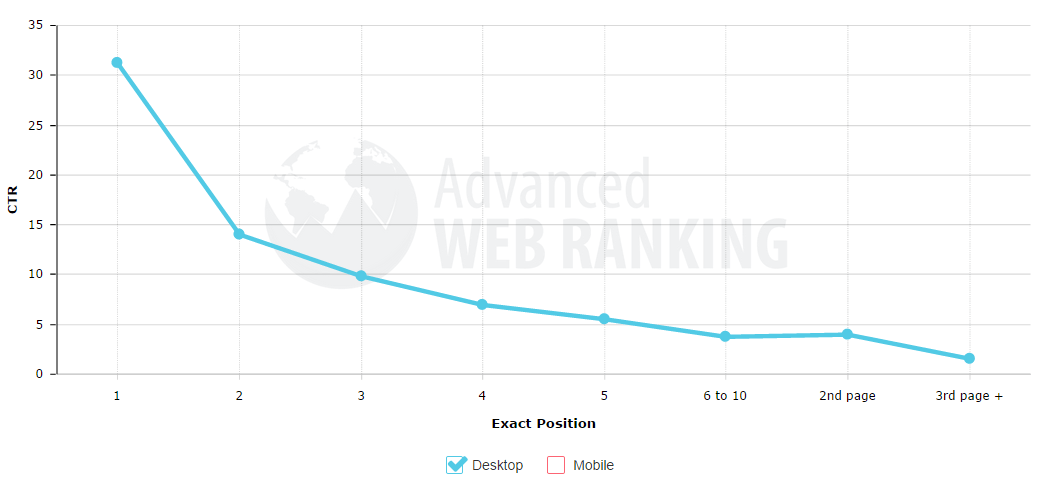

Here is a chart showing the click through rate by exact position:

The study was first presented at SMX East yesterday by Philip Petrescu of Caphyon and then posted on Moz.
The full details of the study break down desktop versus mobile click through rates, branded versus non branded search queries and more. You can download the full study as a PDF over here.
Some opinions expressed in this article may be those of a guest author and not necessarily Search Engine Land. Staff authors are listed here.
(Some images used under license from Shutterstock.com.)
A New Click Through Rate Study For Google Organic Results
Subscribe to:
Posts (Atom)